Energy Storage Breakthroughs: 4 Technologies Poised for 2026-2027 U.S. Market Domination
Energy Storage Breakthroughs: 4 Technologies Poised for 2026-2027 U.S. Market Domination
The global energy landscape is undergoing a monumental transformation, driven by an urgent need for sustainable, reliable, and efficient power solutions. At the heart of this revolution are energy storage breakthroughs, technologies that promise to unlock the full potential of renewable energy sources and create a more resilient grid. The United States, with its ambitious decarbonization goals and growing demand for electricity, is a crucial battleground for these innovations. As we look towards 2026 and 2027, several cutting-edge energy storage technologies are poised not just to enter, but to dominate the U.S. market, fundamentally altering how we generate, distribute, and consume power.
The current energy infrastructure, largely reliant on fossil fuels and a centralized grid, faces increasing pressure from climate change, geopolitical instabilities, and the intermittent nature of renewables like solar and wind. Energy storage is the lynchpin that connects these disparate elements, providing the flexibility needed to balance supply and demand, enhance grid stability, and ensure energy security. Without effective storage, the widespread adoption of renewables remains a challenge, as their output fluctuates with weather patterns and time of day. This is where the true power of energy storage breakthroughs comes into play.
In this comprehensive article, we will delve into four pivotal energy storage breakthroughs that are on the cusp of significant market penetration and widespread adoption in the U.S. by 2026-2027. These aren’t just incremental improvements; they represent paradigm shifts in how we think about storing energy, offering unprecedented levels of efficiency, safety, longevity, and cost-effectiveness. From advanced battery chemistries to innovative thermal and mechanical solutions, the future of energy storage is diverse and dynamic. Understanding these emergent technologies is crucial for policymakers, investors, energy professionals, and anyone interested in the future of our planet’s energy supply.
1. Solid-State Batteries: The Next Generation of Electrochemical Storage
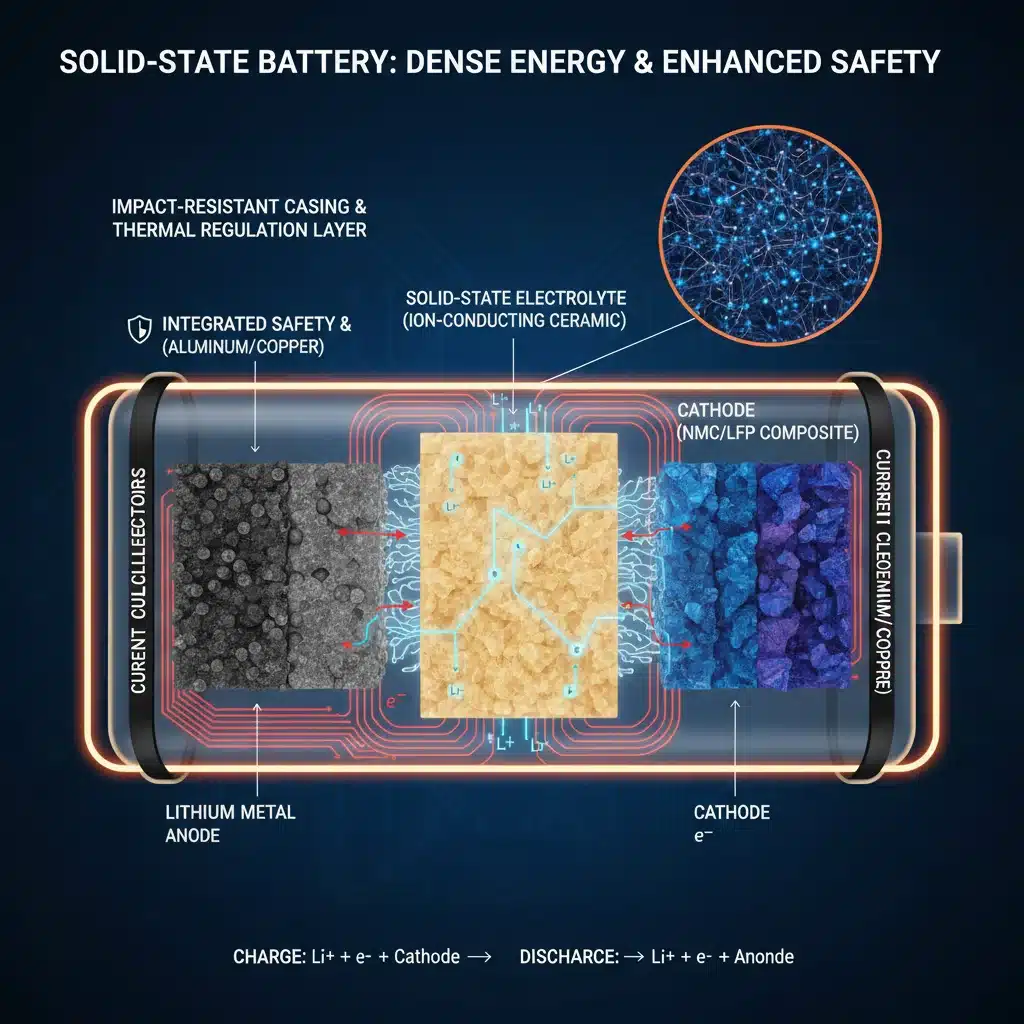
For decades, lithium-ion batteries have been the workhorse of portable electronics and, more recently, electric vehicles and grid-scale storage. However, they come with inherent limitations, including safety concerns (due to flammable liquid electrolytes), degradation over time, and a finite energy density. Enter solid-state batteries (SSBs), one of the most anticipated energy storage breakthroughs. SSBs replace the flammable liquid electrolyte with a solid conductive material, promising a revolution in battery technology.
Why Solid-State Batteries are a Game-Changer
- Enhanced Safety: The elimination of liquid electrolytes significantly reduces the risk of thermal runaway and fires, a critical advantage for large-scale applications and electric vehicles.
- Higher Energy Density: Solid electrolytes allow for the use of lithium metal anodes, which boast a much higher theoretical energy density than conventional graphite anodes. This translates to smaller, lighter batteries that can store more energy, extending the range of EVs and reducing the footprint of grid storage systems.
- Longer Lifespan: SSBs are expected to have a longer cycle life and better calendar life due to reduced degradation mechanisms compared to liquid electrolyte batteries.
- Faster Charging: Some solid-state designs show potential for ultra-fast charging capabilities, addressing a major pain point for EV adoption.
- Wider Operating Temperature Range: Solid electrolytes can often operate effectively across a broader range of temperatures, making them more robust for diverse environments.
Current Status and 2026-2027 Outlook
While solid-state battery technology has been under development for years, significant hurdles in manufacturing scalability and cost have prevented widespread commercialization. However, recent advancements in materials science and manufacturing processes are rapidly bringing SSBs closer to market reality. Major players in the automotive industry (e.g., Toyota, Volkswagen, Ford) and dedicated battery startups (e.g., QuantumScape, Solid Power) are investing heavily, with prototypes demonstrating impressive performance.
By 2026-2027, we anticipate the first wave of commercial solid-state batteries to appear in niche high-value applications, such as premium electric vehicles and specialized grid storage projects where safety and energy density are paramount. While full-scale mass market penetration might still be a few years further out, this period will be crucial for refining manufacturing, reducing costs, and proving their long-term reliability. The initial successes of these energy storage breakthroughs will pave the way for broader adoption in the subsequent decade, fundamentally reshaping the battery industry.
2. Flow Batteries: The Solution for Long-Duration Storage
As renewable energy penetration increases, the need for long-duration energy storage (LDES) becomes critical. LDES systems can store electricity for hours, days, or even weeks, bridging seasonal gaps and ensuring continuous power supply even during prolonged periods of low renewable output. While lithium-ion batteries excel at short-to-medium duration storage, their cost scales linearly with energy capacity, making them less economical for very long durations. This is where flow batteries shine as a significant energy storage breakthrough.
How Flow Batteries Work and Their Advantages
Unlike conventional batteries where energy is stored within the electrode material, flow batteries store energy in liquid electrolyte solutions contained in external tanks. These electrolytes are pumped through a central electrochemical cell where chemical reactions occur, generating or consuming electricity. The power output (determined by the size of the cell stack) and energy capacity (determined by the volume of electrolyte in the tanks) can be scaled independently, offering unmatched flexibility.
- Scalable Long-Duration Storage: The ability to separate power and energy components makes flow batteries ideal for applications requiring many hours or even days of storage at grid scale.
- Long Lifespan and Cycle Life: Flow batteries can undergo tens of thousands of charge/discharge cycles with minimal degradation, often exceeding 20 years of operational life.
- Enhanced Safety: Many flow battery chemistries (e.g., vanadium redox, zinc-bromine) use non-flammable, water-based electrolytes, significantly improving safety compared to lithium-ion.
- Low Self-Discharge: Energy stored in the external tanks experiences very little self-discharge over time.
- Recyclability and Sustainability: The electrolytes can often be reused or recycled at the end of the battery’s life, reducing environmental impact.
Market Trajectory for 2026-2027
While vanadium redox flow batteries (VRFBs) have been the most mature flow battery technology, newer chemistries like zinc-bromine, iron-flow, and organic flow batteries are rapidly gaining traction, promising lower costs and improved performance. Governments and utilities are recognizing the crucial role of LDES in a fully decarbonized grid, leading to increased investment and deployment incentives.
By 2026-2027, flow batteries are expected to move beyond pilot projects and secure a substantial share of the long-duration energy storage market in the U.S. We will see larger deployments integrated with major solar and wind farms, providing critical grid services such as peak shifting, renewable firming, and grid resiliency. The cost-effectiveness of flow batteries for durations exceeding 4-6 hours will position them as indispensable energy storage breakthroughs for grid operators aiming for high renewable penetration.
3. Advanced Adiabatic Compressed Air Energy Storage (A-CAES): Mechanical Might for the Grid
While batteries dominate much of the energy storage conversation, mechanical storage solutions offer unique advantages, especially at very large scales and for long durations. Compressed Air Energy Storage (CAES) has been around for decades, but traditional diabatic CAES systems rely on burning natural gas during the discharge cycle, which is counter-productive to decarbonization goals. Advanced Adiabatic CAES (A-CAES) represents a crucial energy storage breakthrough that eliminates fossil fuel combustion.
The Principles and Benefits of A-CAES
A-CAES systems store energy by compressing air and storing it in underground caverns, salt domes, or above-ground pressure vessels. The key innovation in adiabatic systems is the capture and storage of the heat generated during compression. This stored heat is then used to warm the air during the expansion (discharge) cycle, eliminating the need for supplementary natural gas firing. This makes A-CAES a truly emissions-free, large-scale storage solution.
- Gigawatt-Hour Scale Storage: A-CAES plants can store vast amounts of energy, often in the gigawatt-hour range, making them suitable for regional and even inter-regional grid balancing.
- Very Long Lifespan: With minimal moving parts (compared to batteries) and robust components, A-CAES systems can operate for 30-50 years or more.
- Geographic Flexibility: While underground geological formations are ideal, advancements in above-ground pressure vessel technology are expanding deployment possibilities.
- High Efficiency: Modern A-CAES systems aim for round-trip efficiencies of 70% or higher.
- Non-Degrading Capacity: Unlike batteries, the storage capacity of an A-CAES system does not degrade over time or with cycling.
A-CAES in the U.S. Market by 2026-2027
Several companies are actively developing and deploying A-CAES projects globally, with a strong focus on the U.S. market due to its diverse geology and significant renewable energy integration needs. While the upfront capital costs for A-CAES can be substantial, their long operational life, low operating costs, and massive storage capacity make them highly competitive for specific grid applications.
By 2026-2027, we expect to see groundbreaking ceremonies and initial operational phases of several utility-scale A-CAES projects in the U.S. These projects will play a critical role in providing grid stability, integrating large offshore wind farms and vast solar installations, and offering black start capabilities. As one of the most promising energy storage breakthroughs for grid-scale, long-duration applications, A-CAES will be indispensable for achieving a high-renewable energy future.
4. Advanced Thermal Energy Storage (ATES): Leveraging Heat for Power and Industry
Thermal energy storage (TES) is another often-overlooked but incredibly versatile form of energy storage. While historically used for heating and cooling buildings, advanced thermal energy storage (ATES) systems are emerging as critical energy storage breakthroughs for grid-scale applications, industrial processes, and even concentrated solar power (CSP) plants. ATES systems store energy as heat or cold, which can then be converted back into electricity or used directly.
Diversity and Applications of ATES
ATES encompasses a wide range of technologies, each suited for different temperature ranges and applications:
- Molten Salt Storage: Already proven in CSP plants, molten salt can store heat at very high temperatures (500-600°C) for many hours, allowing CSP plants to generate electricity long after the sun sets.
- Phase Change Materials (PCMs): PCMs store and release large amounts of latent heat during phase transitions (e.g., melting/freezing). They can be tailored for various temperature ranges, from building HVAC to industrial process heat.
- Sensible Heat Storage: Using materials like rocks, concrete, or specialized ceramics to store heat by raising their temperature. This is often used in conjunction with electric heaters for large-scale heat batteries.
- Pumped Heat Energy Storage (PHES): Also known as electro-thermal energy storage (ETES), this system uses a heat pump to store electricity as heat in a thermal reservoir and then converts it back to electricity using a heat engine.
The Role of ATES by 2026-2027
The U.S. industrial sector, a significant consumer of energy, is increasingly looking for cost-effective ways to decarbonize its operations. ATES offers a pathway by enabling the use of renewable electricity to generate and store process heat, replacing fossil fuels. Furthermore, ATES can provide long-duration grid-scale storage by converting stored heat into electricity on demand.
By 2026-2027, we anticipate a surge in ATES deployments, particularly in industrial settings (e.g., steel, chemical, food processing) and as an integral part of new CSP projects. We will also see the emergence of large-scale ‘heat batteries’ connected to the grid, absorbing excess renewable electricity and dispatching it as electricity when needed. These energy storage breakthroughs offer a versatile and often highly efficient solution for sectors where heat is a primary energy demand, or where very long-duration electricity storage is required.
The Broader Impact of Energy Storage Breakthroughs on the U.S. Market
The convergence of these energy storage breakthroughs will have profound implications for the U.S. energy market. The timeline of 2026-2027 marks a critical inflection point where these technologies transition from promising prototypes to commercially viable and widely deployed solutions. This shift will:
- Accelerate Renewable Energy Integration: By providing reliable storage for intermittent solar and wind power, these technologies will enable higher percentages of renewables on the grid, pushing the U.S. closer to its decarbonization targets.
- Enhance Grid Stability and Resiliency: Advanced storage solutions will offer critical ancillary services, such as frequency regulation, voltage support, and black start capabilities, making the grid more robust against outages and disturbances.
- Reduce Energy Costs: As storage costs continue to decline and efficiency improves, these systems will help flatten peak demand, reduce the need for expensive peaker plants, and ultimately lower electricity costs for consumers.
- Foster Energy Independence and Security: A diversified and resilient energy storage portfolio reduces reliance on volatile fossil fuel markets and strengthens national energy security.
- Create New Industries and Jobs: The development, manufacturing, deployment, and maintenance of these advanced storage technologies will spur economic growth and create numerous high-skilled jobs across the country.
- Empower Distributed Energy Resources: While this article focuses on grid-scale, many of these advancements will also trickle down to commercial, industrial, and residential applications, enabling more localized energy independence.
Challenges and Opportunities
Despite the immense promise, the path to widespread adoption of these energy storage breakthroughs is not without challenges. These include:
- Funding and Investment: Significant capital is required for research, development, and large-scale deployment. Government incentives and private investment will be crucial.
- Supply Chain Development: Establishing robust and ethical supply chains for new materials and components will be essential, particularly for solid-state batteries and advanced flow battery chemistries.
- Regulatory Frameworks: Existing regulations may need to be updated to properly value and integrate diverse energy storage technologies into grid operations and market structures.
- Public Acceptance and Education: Ensuring public understanding and acceptance of new energy infrastructure will be important for smooth deployment.
- Interoperability and Standardization: Developing common standards and communication protocols will be vital for seamless integration of various storage technologies into a complex grid.
However, the opportunities far outweigh the challenges. The U.S. is uniquely positioned to lead this energy storage revolution, with a strong research ecosystem, innovative private sector, and growing political will. The Inflation Reduction Act (IRA) and other federal initiatives are providing unprecedented support for domestic manufacturing and deployment of clean energy technologies, including storage.
Conclusion: A Stored Future is a Sustainable Future
The period between 2026 and 2027 represents a pivotal moment for energy storage in the United States. The four energy storage breakthroughs discussed – solid-state batteries, flow batteries, advanced adiabatic compressed air energy storage, and advanced thermal energy storage – are not merely theoretical concepts. They are tangible solutions, backed by rigorous research and significant investment, poised to make a real-world impact.
These technologies will work in concert, forming a diversified portfolio of storage solutions that can address the varied needs of a modern, decarbonized grid. Solid-state batteries will push the boundaries of energy density and safety, transforming electric vehicles and compact grid applications. Flow batteries will provide the long-duration backbone for renewable integration, ensuring power availability around the clock. A-CAES will offer massive, non-degrading storage for regional grid stability, while ATES will decarbonize industrial heat and provide versatile grid support.
The future of energy in the U.S. is increasingly electrified and decarbonized, and reliable energy storage is the critical enabler of this transition. By embracing and scaling these energy storage breakthroughs, the U.S. can solidify its position as a global leader in sustainable energy, ensuring a more stable, secure, and environmentally responsible power future for generations to come. The time to invest, innovate, and integrate these transformative technologies is now.


