Geothermal Energy in 2026: Discovering the 4 Most Promising Next-Gen Drilling Techniques
The quest for sustainable, reliable, and clean energy sources has never been more urgent. As the world grapples with climate change and the need to decarbonize our energy grids, geothermal energy stands out as a powerful, often underestimated, solution. Unlike intermittent sources like solar and wind, geothermal power offers a constant, baseload supply of clean energy, available 24/7, regardless of weather conditions. Its potential is immense, but unlocking it hinges on our ability to access the Earth’s deep heat more efficiently and economically. This is where next-gen geothermal drilling techniques come into play, poised to revolutionize the industry by 2026.
Geothermal energy harnesses the natural heat within the Earth. This heat originates from the planet’s formation and the radioactive decay of materials in its core. While conventional geothermal power plants typically rely on hydrothermal reservoirs – areas where hot water and steam naturally rise close to the surface – these locations are geographically limited. The true prize lies in accessing the vast, ubiquitous heat stored in hot dry rock formations, which are far more common globally. However, drilling deep into these hard, abrasive rocks at extreme temperatures and pressures presents significant engineering challenges. Traditional drilling methods, primarily adapted from the oil and gas industry, are often too slow, expensive, and limited in their depth capabilities for widespread geothermal deployment.
The good news is that a new wave of innovative drilling technologies is emerging, promising to overcome these barriers. These advancements are not just incremental improvements; they represent fundamental shifts in how we interact with the Earth’s subsurface. By 2026, several cutting-edge techniques are expected to mature, making deep geothermal resources accessible in more regions, reducing costs, and accelerating the transition to a cleaner energy future. This article will delve into the four most promising next-gen geothermal drilling techniques that are set to redefine the landscape of geothermal energy.
The Imperative for Advanced Drilling in Geothermal Energy
Before we dive into the specific technologies, it’s crucial to understand why advanced drilling is so critical for geothermal energy. The Earth’s crust is a vast heat battery, but its energy density increases with depth. To generate significant amounts of power, we need to reach temperatures of 150-200°C (300-400°F) or more, often requiring drilling to depths of 3-10 kilometers (2-6 miles). At these depths, rock formations are incredibly hard, hot, and often under immense pressure. Conventional rotary drilling, while effective for shallower oil and gas wells, faces severe limitations:
- High Costs: Drilling deep wells is extraordinarily expensive, with costs escalating exponentially with depth and temperature. This is a major barrier to project viability.
- Slow Penetration Rates: Hard, hot rock significantly slows down drilling, leading to extended project timelines and increased operational expenses.
- Tool Wear and Failure: Conventional drill bits and downhole tools are not designed to withstand the extreme temperatures and abrasive conditions encountered in deep geothermal environments, leading to frequent failures and costly trips to replace equipment.
- Lost Circulation: Fractured formations can lead to drilling fluid loss, causing instability and operational delays.
- Limited Access: Many promising geothermal resources are in hot dry rock formations without natural fluid pathways, necessitating enhanced geothermal systems (EGS) that require precise drilling and hydraulic stimulation.
These challenges highlight the urgent need for innovative solutions. The next-gen geothermal drilling technologies we will explore aim to address these issues head-on, promising faster, cheaper, and more reliable access to the Earth’s boundless heat.
1. Plasma Drilling / Millimeter Wave Drilling
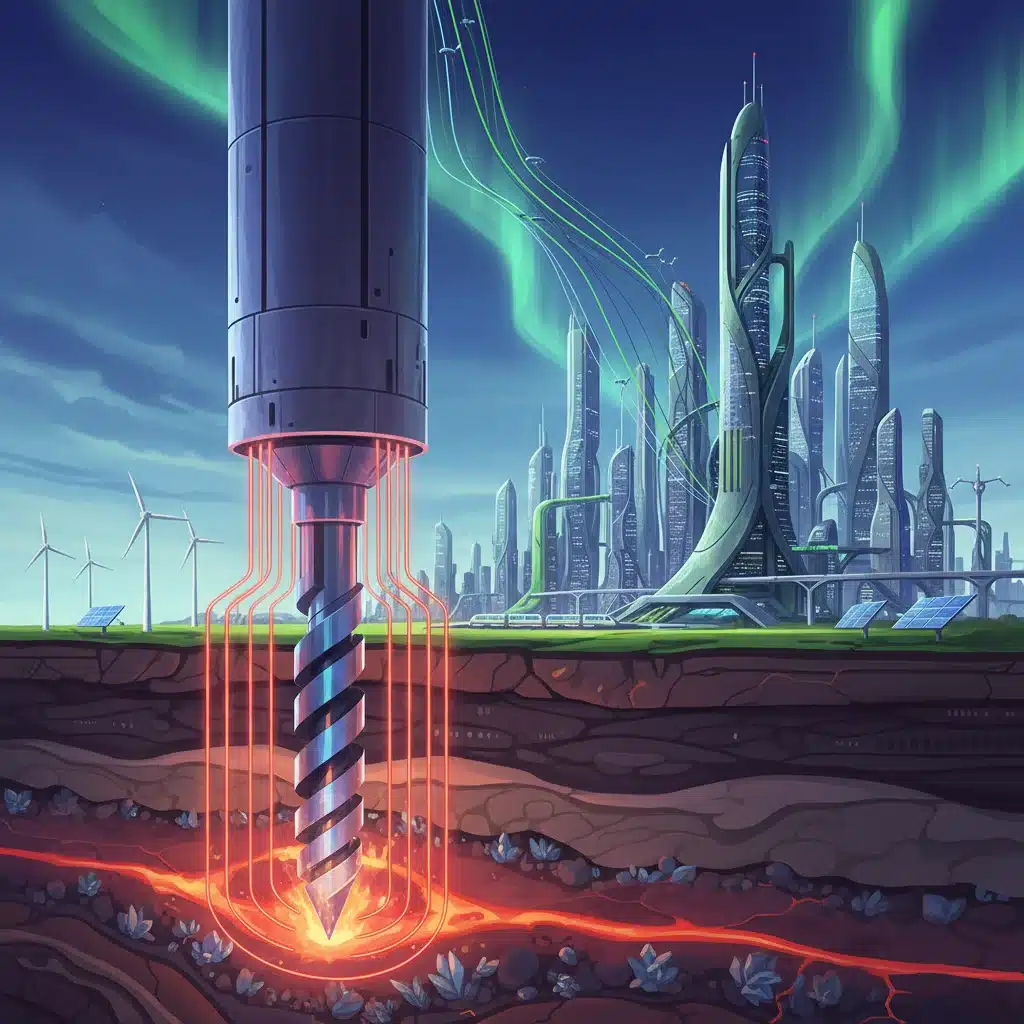
Imagine drilling through solid rock not with a mechanical bit, but with superheated plasma or high-frequency electromagnetic waves. This is the promise of plasma drilling, often referred to as millimeter wave drilling or directed energy drilling. Instead of physically grinding rock, these methods use intense energy to melt, spall, or vaporize the rock, creating a borehole.
How it Works:
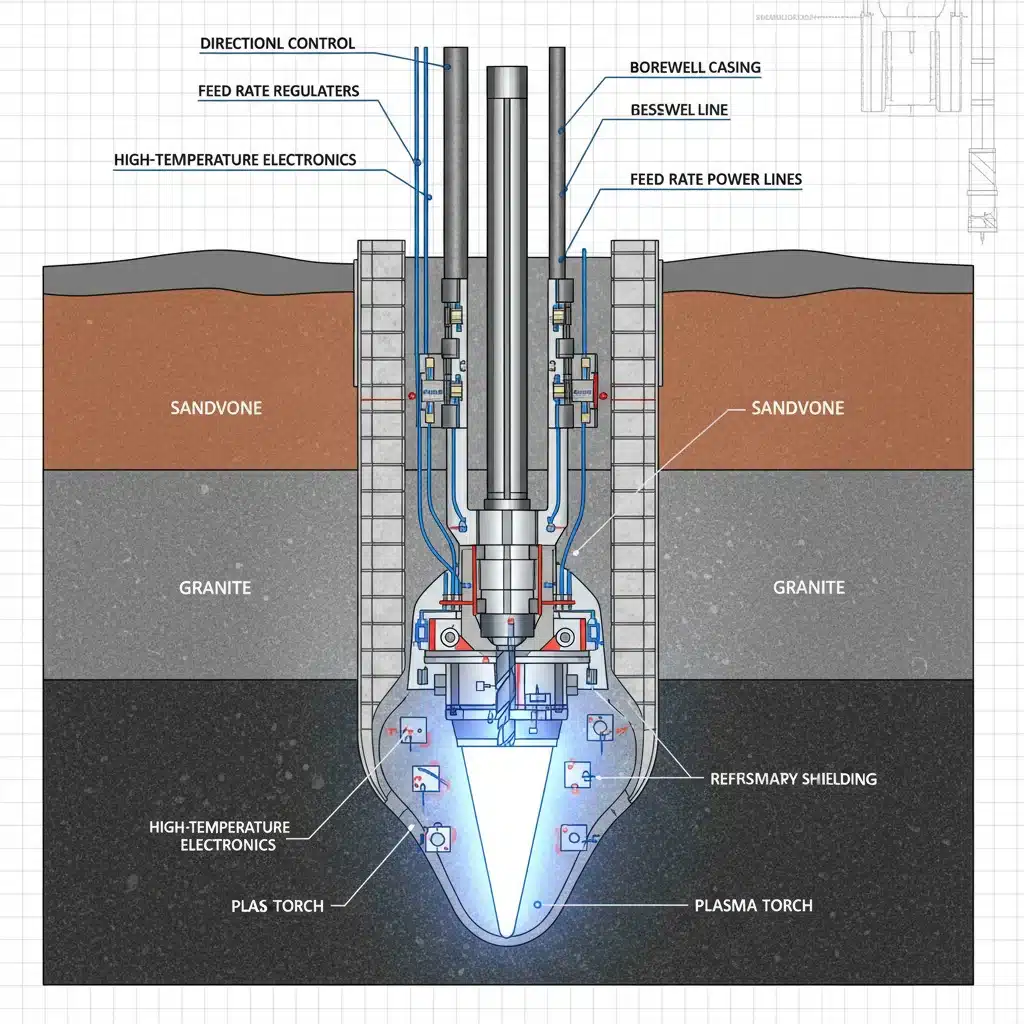
Plasma drilling involves generating a high-energy plasma jet at the bottom of the well. This plasma, reaching thousands of degrees Celsius, is hot enough to melt and vaporize even the hardest rocks. The molten rock is then either ejected as slag or solidified into a smooth, strong borehole lining. Millimeter wave drilling, on the other hand, uses high-frequency electromagnetic waves (similar to those in microwave ovens, but far more powerful and focused) to heat and fracture the rock, which can then be removed more easily.
Advantages for Geothermal:
- Increased Penetration Rates: These methods can achieve significantly faster drilling rates in hard, crystalline rocks compared to rotary drilling, drastically reducing drilling time.
- Reduced Tool Wear: Since there’s no direct mechanical contact with the rock, the problem of drill bit wear and failure is virtually eliminated, leading to fewer costly interruptions.
- Borehole Stability: The intense heat can fuse the rock walls, creating a naturally cased and stable borehole that may require less additional casing, further reducing costs and improving well longevity.
- High Temperature Resistance: The drilling mechanism itself is designed to operate in extreme heat, making it ideal for deep geothermal environments.
- Directional Drilling: The directed energy can potentially allow for more precise control over borehole direction, crucial for complex EGS reservoirs.
Challenges and Outlook for 2026:
While highly promising, plasma and millimeter wave drilling are still in advanced research and development phases. Key challenges include miniaturizing the power generation and transmission systems for downhole environments, managing energy efficiency, and effectively removing debris. However, significant progress is being made by companies like Quaise Energy, which is developing millimeter wave drilling technology with the goal of reaching depths of 20 kilometers. By 2026, we can expect to see proof-of-concept demonstrations and potentially early commercialization for specific applications, marking a pivotal step in next-gen geothermal drilling.
2. Percussive Drilling with Advanced Hammer Technology
Percussive drilling is not new; it’s been used for centuries. However, modern advancements in hammer technology are transforming this method into a viable solution for deep geothermal. Unlike rotary drilling that grinds rock, percussive drilling uses rapid, high-impact blows to shatter the rock, combined with rotation to clear the debris.
How it Works:
Downhole hammers, powered by compressed air, drilling fluid, or even electrically, deliver thousands of impacts per minute to the drill bit. These impacts create micro-fractures in the rock, which are then cleared by rotation. The key innovations lie in developing hammers that can withstand extreme temperatures and pressures, and in optimizing the energy transfer to the rock.
Advantages for Geothermal:
- High Penetration Rates in Hard Rock: Percussive drilling is exceptionally effective in hard, brittle rock formations where rotary drilling struggles, offering significantly faster penetration rates.
- Reduced Weight on Bit: Less weight is needed from the surface rig, potentially allowing for lighter, more mobile drilling equipment.
- Improved Bit Life: While still subject to wear, modern percussive bits are designed with advanced materials and geometries to resist the harsh conditions, leading to better longevity than conventional rotary bits in tough environments.
- Adaptability: This technology can be integrated with existing drilling rigs, making its adoption potentially faster and less capital-intensive than entirely new drilling paradigms.
Challenges and Outlook for 2026:
The main challenges for percussive drilling in deep geothermal are the durability of downhole hammer components at extreme temperatures (above 250°C), noise and vibration management, and efficient debris removal. Companies like Fervo Energy are already deploying advanced percussive drilling techniques in their Enhanced Geothermal Systems (EGS) projects, showcasing its efficacy. By 2026, we anticipate continued development of high-temperature resistant materials and smart hammer designs, making percussive drilling a more robust and widespread option for next-gen geothermal drilling, especially for initial wellbore creation in challenging formations.
3. Advanced Rotary Drilling with Hybrid Bits and Automation
While revolutionary techniques like plasma drilling capture the imagination, significant incremental advancements in traditional rotary drilling are also making a substantial impact. This category focuses on optimizing and enhancing the existing rotary drilling paradigm through material science, bit design, and automation.
How it Works:
This involves the development of hybrid drill bits that combine different cutting mechanisms (e.g., PDC cutters with roller cones), advanced materials like polycrystalline diamond compact (PDC) cutters optimized for high temperatures and abrasion, and sophisticated drilling automation systems. Automation uses sensors and AI to monitor drilling parameters in real-time, adjusting weight on bit, rotation speed, and fluid flow to maximize efficiency and prevent failures.
Advantages for Geothermal:
- Increased Efficiency: Hybrid bits and optimized drilling parameters lead to faster penetration rates and longer bit life, even in challenging geothermal formations.
- Reduced Non-Productive Time: Automation minimizes human error and allows for proactive problem-solving, reducing costly downtime associated with tool failures or drilling inefficiencies.
- Improved Wellbore Quality: Better control over drilling parameters results in smoother, more stable wellbores, reducing the need for extensive casing and improving well longevity.
- Lower Costs: By increasing speed and reducing failures, overall drilling costs per meter can be significantly lowered, making more geothermal projects economically viable.
- Mature Technology Base: Building upon existing rotary drilling infrastructure and expertise means faster deployment and fewer fundamental technological hurdles.
Challenges and Outlook for 2026:
The primary challenges lie in pushing the limits of material science for new bits and downhole tools to withstand even higher temperatures and pressures, and in integrating complex automation systems seamlessly. However, this is an area of continuous and rapid development. Companies across the drilling sector are heavily investing in these advancements. By 2026, advanced rotary drilling with hybrid bits and sophisticated automation will be a standard practice for many geothermal projects, significantly improving the economic feasibility and operational efficiency of next-gen geothermal drilling.
4. Closed-Loop Geothermal Systems with Innovative Drilling
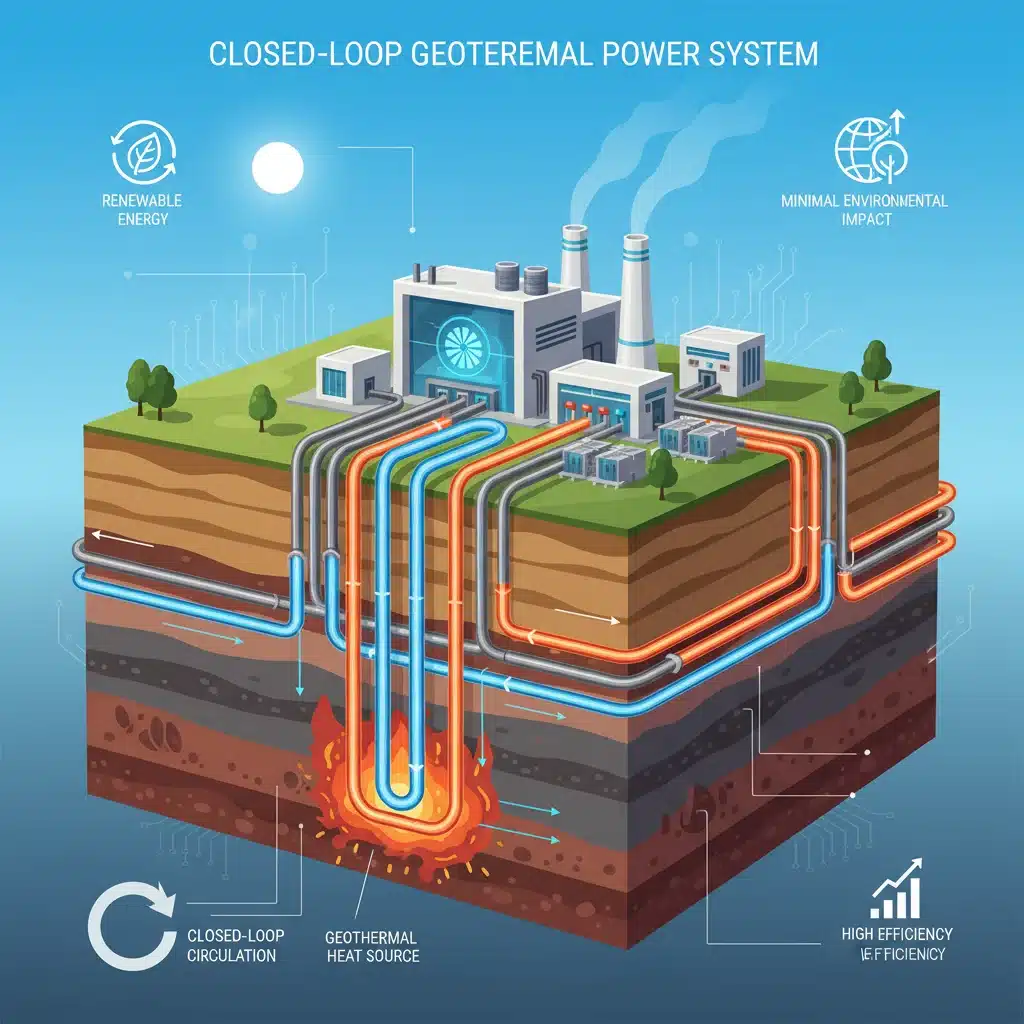
While not strictly a drilling technique in isolation, the development of closed-loop geothermal systems profoundly influences and demands innovative drilling approaches. Traditional geothermal often involves injecting water into hot rock and then extracting the resulting steam or hot water. Closed-loop systems circulate a working fluid (like water or a supercritical fluid) through sealed pipes deep underground, extracting heat without direct fluid-rock interaction or fluid loss. This eliminates many of the geological risks and environmental concerns associated with conventional geothermal, making it deployable almost anywhere.
How it Works:
Closed-loop systems typically involve drilling multiple parallel or concentric boreholes, often in a ‘U-tube’ or ‘coaxial’ configuration, to create a large subsurface heat exchanger. The drilling challenges here are less about penetrating the hardest rock and more about precision, creating multiple wells in close proximity, and ensuring integrity for the sealed loops. This often involves advanced directional drilling, multilateral drilling, and potentially even horizontal drilling techniques to maximize the heat exchange surface area.
Advantages for Geothermal:
- Ubiquitous Resource: Closed-loop systems can be deployed in almost any geological setting, removing the geographic limitations of conventional hydrothermal resources.
- No Water Usage/Loss: Eliminates concerns about water availability, seismic activity from hydraulic fracturing, and contamination of groundwater.
- Reduced Geological Risk: Less reliance on specific rock permeability or fluid pathways.
- Environmental Friendliness: No emissions of greenhouse gases or other fluids from the subsurface.
- Scalability: Can be scaled from small, distributed systems to large utility-scale power plants.
Challenges and Outlook for 2026:
The main challenge is achieving sufficient heat exchange within the drilled loops to make power generation economically viable. This requires either very deep drilling (3-10+ km) to reach higher temperatures or creating very long, extensive subsurface heat exchangers. The drilling costs for creating these intricate well designs can be significant. However, companies like Eavor and Sage Geosystems are making rapid strides in demonstrating the viability of closed-loop systems. By 2026, with breakthroughs in advanced directional drilling and potentially the integration of other next-gen geothermal drilling techniques (like plasma drilling for deeper sections), closed-loop systems are expected to move from pilot projects to initial commercial deployment, opening up geothermal energy to a vastly expanded market.
The Interplay of Technologies and the Road Ahead
It’s important to recognize that these next-gen geothermal drilling techniques are not mutually exclusive; they are often complementary. For instance, plasma drilling could be used to create the initial deep boreholes in extremely hard rock, followed by advanced rotary drilling for shallower sections or for creating precise directional pathways for closed-loop systems. Automation will be critical across all methods to optimize performance and reduce costs.
The convergence of these technologies, coupled with advancements in subsurface imaging, materials science, and reservoir engineering, paints a very promising picture for geothermal energy by 2026 and beyond. The global energy transition demands not just more renewable energy, but reliable, scalable, and dispatchable clean energy. Geothermal, with these drilling innovations, is uniquely positioned to deliver precisely that.
Economic Impact and Investment
The economic implications of these drilling breakthroughs are profound. By reducing drilling costs and increasing success rates, geothermal projects will become more attractive to investors, accelerating deployment. This will not only create jobs in the energy sector but also foster local economic development in regions where geothermal resources become newly accessible. Government support, through R&D funding and policy incentives, will be crucial in de-risking these technologies and speeding their path to commercialization.
Environmental Benefits
Beyond the economic advantages, the environmental benefits are paramount. Widespread deployment of enhanced geothermal systems, enabled by next-gen geothermal drilling, means a significant reduction in greenhouse gas emissions, decreased reliance on fossil fuels, and a more stable, resilient energy grid. Geothermal power plants typically have a small land footprint compared to other renewables and operate with minimal environmental impact once constructed.
Conclusion: A Hot Future for Geothermal
The year 2026 is shaping up to be a landmark year for geothermal energy. The confluence of urgent climate action, technological innovation, and increasing investment is creating a fertile ground for these transformative drilling techniques. Plasma/millimeter wave drilling, advanced percussive methods, enhanced rotary drilling with automation, and the integration of these into closed-loop systems are collectively pushing the boundaries of what’s possible. These next-gen geothermal drilling technologies are not just theoretical concepts; they are rapidly moving from laboratories to the field, promising to unlock the Earth’s immense heat potential and secure a cleaner, more sustainable energy future for generations to come. The journey to deep, ubiquitous geothermal energy is well underway, and by 2026, we will undoubtedly witness significant milestones in this exciting frontier.


